While the world’s attention is directed to Ukraine – AND BOTH HUMAN AND MATERIAL SUPPORT FOR THE UKRAINIAN PEOPLE IS WHAT MATTERS MOST IN THESE MOMENTS – there are some implications on the world of investments that should not be ignored.
At the end of last year, I was mentioning that the Romanian market is favored by financial investors, whenever there are tensions in Ukraine or Turkey. At that time, although there were political tensions and uncertainties, I did not believe for a second that a real war will start in Ukraine.
Could this current situation have an impact on the M&A activity in the entire South-Eastern Europe area? I’m afraid so. And it will hit hard. So what is the real impact of the Ukrainian war over PE?
Less transactions closed in the near future
Private equity funds are nice organisations to work with – and for – in peaceful times of development. In bad times, however, they become very cautious and prudent. Probably most such regional financial investors with exposures in Ukraine are now trying to assess the situation and, for the next step, to come up with plans to limit losses. The remedial actions will turn their attention from new potential investments for a period of time. A couple of funds that were in discussions for potential investments have already put on hold such new developments.
The closure of the Russian market and (hopefully temporary) collapse of the Ukrainian supply chain will disrupt the business of many companies active in the region. While on one hand the market for some products/services is simply gone, the raw materials supply chain will also be disrupted, thus generating gaps in production flows. Referring to a recent case, the car manufacturer Volkswagen has reported the inevitable closing of two plants, due to the lack of materials supply from Ukraine.
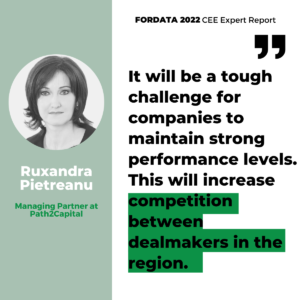
Companies that already have shareholders with deep pockets will be more protected, since they will put new money in until the situation will be balanced. Still, this will also mean less new investments, because financial investors will support existing portfolio companies in order to stay above the water, rather than going after new ones. The impact of the Ukrainian war is no small thing.

A new investment thesis
The whole investment activity in the region will be impacted for years from now. US’ and EU’s ban over Russian activities will force private equity funds that have US and European investors to avoid any kind of partnership with Russia-related entities or individuals, as well.
In layman’s terms, this means:
- Uncertainties in respect of the CEE and SEE regions’ future, as it might push back investors;
- Reassessment or postponement of ongoing transactions until the political situations is stable;
- New investments being made after investors carefully scrutinize the business affiliations, as well as business relationships of target-companies;
- No investments into companies that might be considered affiliated to Russia;
- No investments will go into companies depending on the Russian markets or any kind of supply;
- Cherry-picking viable and profitable companies that will remain strong in the face of worsening market conditions.
Can we assess the impact of the Ukrainian war?
This stupid war did not end and is still early to predict the outcome. The Romanian civil society has mobilized in an exemplary manner in order to support our Ukrainian neighbours in need. Irrespective of individual opposing views and opinions, Ukrainians are people suffering because of decisions made by others. They, and all of us as a free society, are collateral victims.
While on a human level we stand stronger when supporting each other, on an economic level the implications will go far beyond Ukrainian borders. In today’s world, European countries are so dependent on others, that the collapse of any one of them will spread across the region. It is just better to be realistic and be prepared. This year will no longer be what we hoped it will be, when making personal resolutions two months ago.

Ruxandra is an M&A expert with 20+ years of experience in investments field.
Her professional expertise has been built in a large number of projects – covering M&A, capital raising, debt raising, financial & operational restructurings and turnaround situations – serving mid-size and large companies.